
Choose a comfortable bus seat around your habits: some passengers want a view through the window, while others prefer to get up easily at stops. There is no single best row for everyone. Before paying for a selected seat, establish whether the number is assigned to you, whether selection is included in the fare and how accurately the diagram represents the vehicle on your particular departure.
Start with the departure conditions
A seating diagram explains the arrangement of seats but does not itself confirm the interior equipment. A socket, reclining backrest or extra space between rows should be stated in the conditions or confirmed by the carrier. Do not apply the experience of a previous trip to another departure, even with the same company.
Check whether the ticket includes an assigned seat, paid selection is available or seating is decided at boarding. If there is no number, wait for the crew’s instructions before taking your preferred seat. When travelling together, check the possibility of adjacent seats before booking. Buying tickets in one order does not always mean sitting next to each other.
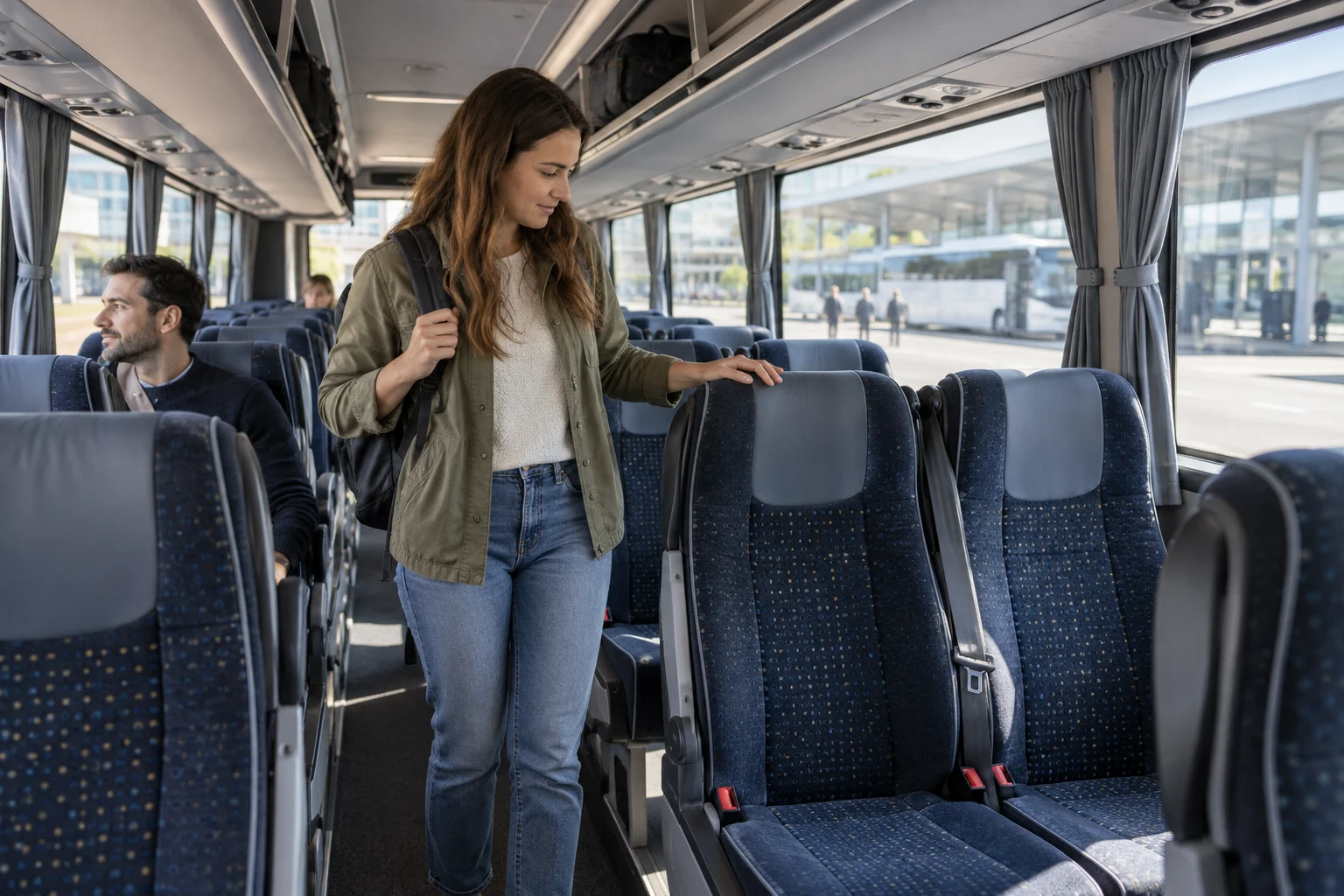
Window or aisle
A window seat is convenient for watching the road and resting without letting other passengers pass. Leaving the row is usually less convenient: you may need to ask your neighbour to stand or move. Consider that if you intend to get out at every stop. Do not lean against the glass in a way that prevents the belt from fitting correctly.
An aisle seat makes leaving the row easier, but people carrying bags will pass beside you. Keep elbows, legs and hand luggage within your seat space. Even a small backpack must not block the aisle, which is needed for movement and the exit. Weigh these differences against your habits rather than someone else’s ranking of seats.
Where the row is located
Being close to a door can simplify boarding, although there may be more movement and conversation during stops. Near a toilet, if the coach has one, there may be more passing passengers. In some buses the last row has a different reclining mechanism or distance to neighbouring seats; this is a design issue rather than a universal rule.
Do not assume every front row is the most spacious. It may look convenient on the diagram but have a partition in front of your legs. If space matters because of your height or mobility requirements, ask for specific information. If you need boarding assistance, arranging that assistance and a suitable vehicle in advance is more useful than simply choosing a seat by the door. Read the guide to accessible bus travel.
Travelling with a child or a group
Discuss who needs aisle access, who prefers a window and how important neighbouring seats are. Do not rely on swapping on board: another passenger may have paid to select their seat. A polite request is fine, but a refusal needs no explanation. Agree a swap with the crew first, especially where seats are numbered.
For a child, ask the carrier about tickets, separate seats and restraint equipment. An empty seat does not mean a child may lie there while the vehicle is moving. The guide to travelling with a child helps you prepare questions before buying.
If the vehicle is replaced
A replacement bus may have a different seating arrangement. Find out how the carrier handles your selected seat and any selection fee. Save the order confirmation showing the number and conditions. At boarding, compare the ticket with the crew’s instructions; if your seat is occupied, show the confirmation and ask for help rather than arguing with your neighbour.
Check the belt and place belongings where they do not obstruct your legs. Keep documents, water and a charger in a small bag. Put a large suitcase in the designated compartment: the luggage preparation guide explains what to check in advance. A selected seat improves comfort but does not replace correct seating and following the crew’s instructions.
← Back to the journal